
Crystal Structure
Theory
Matter exist usually in solid or fluid (liquid, gas) state. According to modern concept matter classification is specified as condensed state and gaseous state. Solids and liquids come under condensed state. Any material whose position of constituent particles is fixed can be regarded as solids.
Solids are characterized by incompressibility, rigidity and mechanical strength. This indicates that the molecules, atoms or ions that make up as solid is closely packed. Thus in solids we will have a well ordered molecular, atomic or ionic arrangement.
In general solids can be classified into:
- Crystalline-particles are orderly arranged (long range order).
- Amorphous-particles are randomly oriented.
If the atoms or molecules are uniquely arranged in crystalline solid or liquid we call it as a crystal structure. A crystal posses long range order and symmetry. The main property of crystal structure is its periodicity. This periodicity is due to the arrangement of atoms/molecules in the lattice points. The crystal structure as a whole can be considered as the repetition of unit cell. For a given crystal structure the shape of unit cell is same but varies from crystal to crystal.
X-ray diffraction studies reveal that the constituent particles (molecules, atoms or ions) are arranged in a definite pattern in the crystal. To get the diffraction pattern the wavelength of light used must be comparable with the atomic spacing.
Lattice
A crystal structure is formed only when the group of atoms is arranged identically at the lattice point. The group of atoms or molecules is called a basis. Lattice point is actually an imaginary concept.
In other way, we can say that,
Lattice + Basis=crystal structure
Line joining any two points is a translation in lattice. Two non-collinear translation leads to a plane lattice and three non coplanar translation leads to a space lattice.
Unit cell
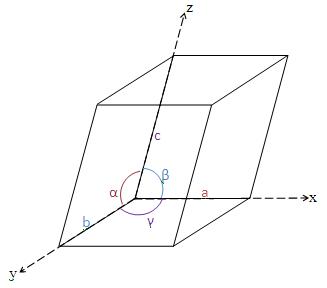
Unit cell can be considered as the building block of a crystal. It has the same symmetry as the entire crystal. When we arrange the unit cell in 3D, we get the bulk crystal. In other words it can be described as the smallest volume which when repeated in all direction gives the crystal. The three edges a, b, c along the axis and angle between them α, β and γ is termed as lattice parameters. In 3D it is better to consider a parallelepiped as unit cell.
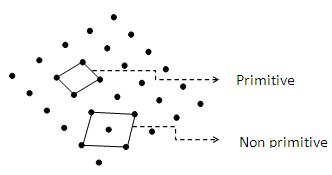
Unit cell can be of primitive as well as non primitive type. A primitive cell is a minimum volume unit cell and has only one lattice point in it and the latter contains more than one.
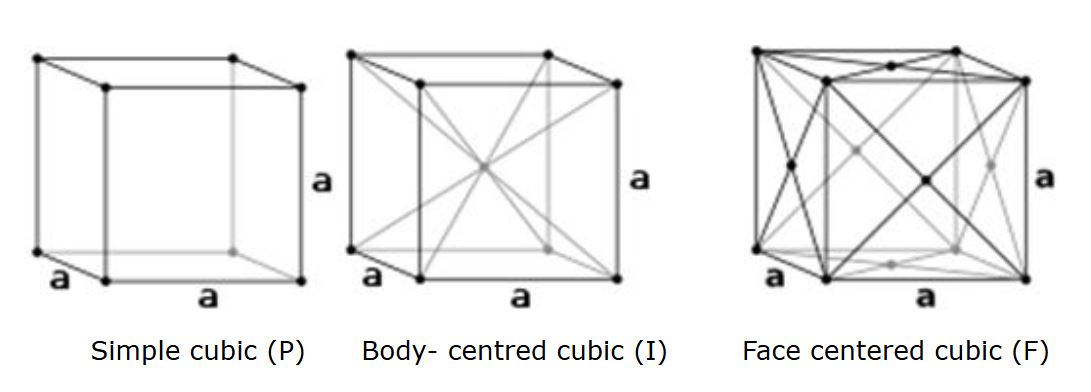
In the given figure below, simple cube is a primitive cell. No.of atoms per unit cell is one for it. The rest two is non primitive. No.of atoms per unit cell is 2 and 4 respectively.
Bravais Lattice in Two Dimensions - Plane Lattice
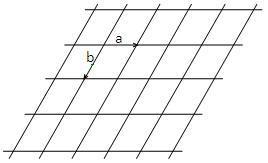
In general, the number of lattices obtained is unlimited since there is no restriction on the length of the lattice translations or the angle between them. Such a lattice for arbitrary and is known as an oblique lattice. This oblique lattice is invariant under rotation of (with and ). It can also be made invariant under rotation of with and .
Special Cases:
- For and : Square lattice
- For and : Rectangular lattice
- For and : Rhombus lattice
- For and : Hexagonal lattice
Bravais Lattice in Three Dimensions - Space Lattice
Based on the lattice parameters and applying certain restrictions, only 14 types of lattices are possible in three dimensions: one general (triclinic) and thirteen special types.
Only seven different systems of axes are sufficient to represent all Bravais lattices. These fourteen space lattices are grouped into seven crystal systems.
The Seven Crystal Systems:
- Triclinic
- Monoclinic
- Orthorhombic
- Tetragonal
- Trigonal
- Hexagonal
- Cubic
| Serial No: | Lattice Systems | Simple | Base-centered | Body-centered | Face-centered | Example |
|---|---|---|---|---|---|---|
| 1 | Triclinic (none) | 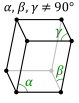 |
CuSO₄·5H₂O, K₂Cr₂O₇ | |||
| 2 | Monoclinic (1 diad) | 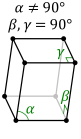 |
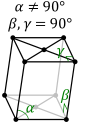 |
CaSO₄·2H₂O, FeSO₄, Na₂SO₄ | ||
| 3 | Orthorhombic (3 perpendicular diads) | 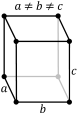 |
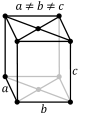 |
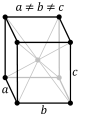 |
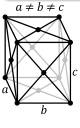 |
KNO₃, BaSO₄ |
| 4 | Rhombohedral (1 triad) | 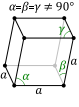 |
As, Sb, Bi | |||
| 5 | Tetragonal (1 tetrad) | 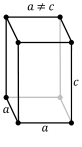 |
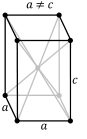 |
TiO₂, SnO₂, NiSO₄ | ||
| 6 | Hexagonal (1 hexad) | 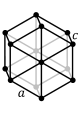 |
SiO₂, Zn, Mg, Cd | |||
| 7 | Cubic (4 triads) | 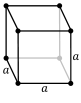 |
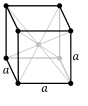 |
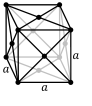 |
Au, Cu, NaCl |
Atomic Packing Fraction (APF)
Atomic packing fraction mainly gives us an idea about the arrangement of atoms/ions in solids. It will give the efficiency with which the available space is being filled by atoms.
Packing fraction is defined as the ratio of volume of atoms occupying the unit cell to the volume of unit cell.
Examples:
- Simple Cubic
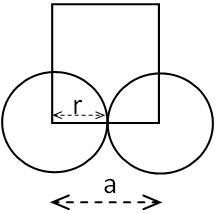
Consider a cube of side 'a' .Atoms of radius 'r' is placed at the corner. So that length of cube a=2r.
In a simple cubic structure, the atoms occupies at the eight corners. An atom at the corner is equally shared by 8 unit cells. So the contribution of one atom to a unit cell is 1/8. Therefore the no. of atoms per unit cell is (1/8)*8(corner atoms) =1.
- Body-Centered Cube
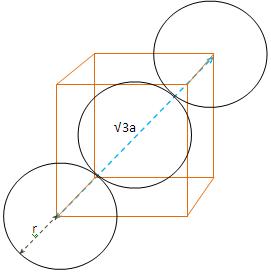
Consider a cube of side , and atoms of radius placed at the corners and at the body center. The length of the body diagonal is given by:
In a body centered cube, there will be one atom at the centre along with 8 corner atoms. This corner atom is shared by 8 unit cell and the atom at the centre is not a shared one. Therefore no. of atoms per unit cell= (1/8)*8(corner atoms)+1(body centre)=2.
- Face-Centered Cube
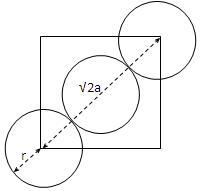
Consider a cube of length , and atoms of radius placed at the corners as well as at the face centers.
The length of the face diagonal is given by:
In a face centered cube, each face possess one atom along with 8 corner atoms. The atoms at the faces are equally shared by two unit cell. Corner atoms by 8 unit cells. So the no. of atoms per unit cell is=(1/8)*8(corner atoms)+(1/2)*6(atoms at face)=4.